

Summary
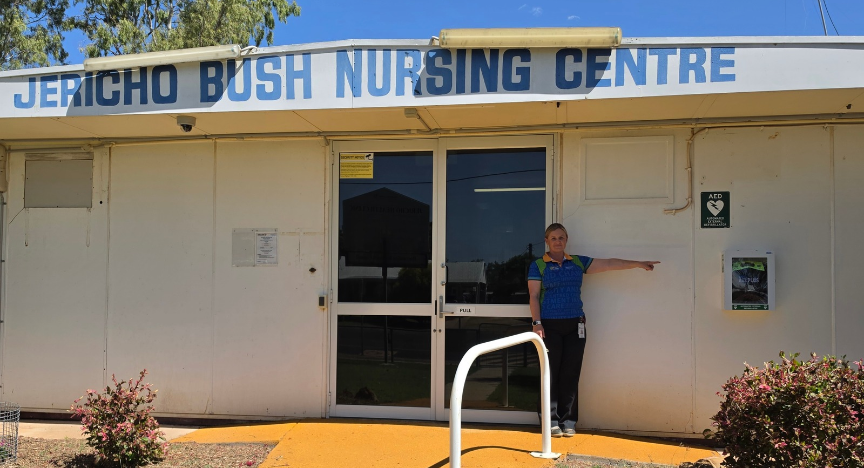
A new Automated External Defibrillator (AED) is now available for emergency use on the outside of the Jericho Primary Health Centre.
A new Automated External Defibrillator (AED) is now available for emergency use on the outside of the Jericho Primary Health Centre.
The defibrillator is a life-saving medical device that can be used to restore a normal heart rhythm during sudden cardiac arrest by delivering an electric shock to the heart.
Central West Hospital and Health Service Executive Director of Nursing and Midwifery Services Troy Lane said the health service was in the process of installing additional AEDs for emergency use at all primary health care centres in the region.
“We already have defibrillators for use internally by staff at all our primary health centres, but these additional AEDs are being mounted at facilities for public access in an emergency,’’ he said.
Jericho PHC Clinical Nurse Lucy Colahan said the new public AED was safe to use by anyone.
“The AED can detect life-threatening, irregular heart rhythms and then use electricity to ‘reset’ the heart,’’
Ms Colahan said.
“The device provides easy to follow voice prompts to guide users and will only deliver a shock if necessary.
“Using an AED, particularly within the first 3–5 minutes of cardiac arrest, significantly increases survival rates.’’
Ms Colahan said the AED could detect life-threatening, irregular heart rhythms and use electricity to "reset" the heart.
“In an emergency, you should always call triple 000 first,’’ she said.
“But if someone goes into cardiac arrest suddenly before help arrives, using the AED will help save their life and people should not hesitate to use it.’’
Usage
1. Turn on the AED and follow the audio instructions.
2. Apply adhesive pads to the bare chest, exactly as pictured on the device.
3. If a shock is advised, ensure no one is touching the patient and press the button (or let the
automatic device deliver it).