

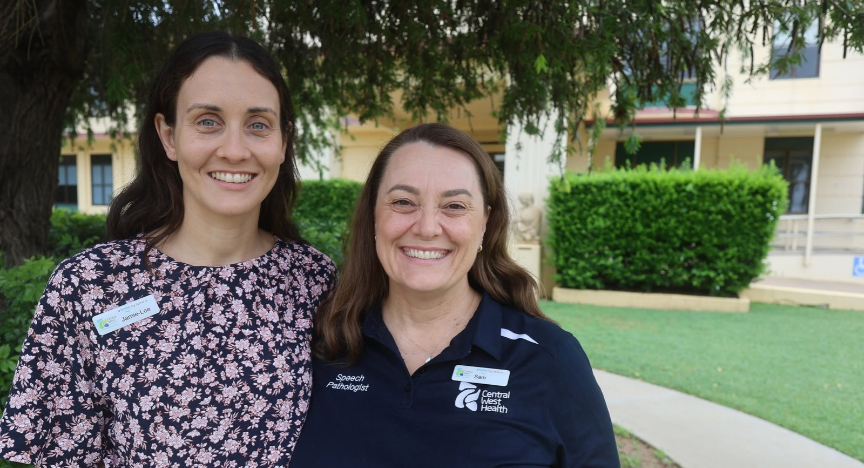
 Speech pathologists Jamie-Lee Tarver and Samantha Nyman are based in Longreach but deliver outreach services across much of the Central West.
Summary
Central West Hospital and Health Service speech pathologists are keen to get the word out about their services around the region this Speech Pathology Week.
Central West Hospital and Health Service speech pathologists are keen to get the word out about their services around the region.
“With Speech Pathology Week being observed from 23–29 August, we want to let Central West residents know about our services and what we can do for them,’’ Central West Senior Speech Pathologist Jamie-Lee Tarver said.
Ms Tarver said this year's theme for the week, Communication creates possibility, reflected what speech pathologists saw every day in practice.
“When communication and swallowing needs are supported, people have more opportunities to connect, learn, make choices, participate and thrive,’’ she said.
“My colleagues and I are here to help adults and children up to school-age with any such swallowing and communication problems.
“Our Central West speech pathology team is based in Longreach and delivers outreach services to Alpha, Blackall, Barcaldine and Winton, as well as servicing Longreach.’’
Ms Tarver said more than 1.1 million Australians had a communication or swallowing disorder that impacted on their daily life.
“Like mobility or wheelchair access, communication access allows people with communication disorders to get their message across by removing barriers to effective communication or providing extra support and strategies.
“That’s what speech pathologists – or ‘speechies’ – are trained to help people with.
“Our speech services begin with initial screening for communication and swallowing disorders.
“We then continue with assessment and diagnosis and then consultation for the provision of advice regarding management, intervention, and treatment.
“We also provide counselling and follow-up services for whatever disorders clients are experiencing.’’
Ron and Moira Kent are Blackall residents and Mr Kent has been a client of the Central West speech pathology service for the past month and has already seen the benefits.
Mr Kent was diagnosed with Parkinson’s Disease some years ago and was having difficulties in conversation.
“It’s very depressing when you lose your speech,’’ Mr Kent said.
“It makes you not very sociable because you are struggling to get people to understand you.
“But I’ve been working with my speech pathologist Samantha Nyman who has given me a therapy program that has helped me reduce my slurring at end of sentences and helped me speak more clearly.
“It’s made me more inclined to speak with people now because I know they can understand me better.’’
Mr Kent said the therapy program he had been given also included exercises to strengthen his throat muscles.
“I do these exercises morning and evening for about 20 minutes each and it’s really made a difference.’’
Mrs Kent said her husband was so much more confident speaking with people now than before he had started on his therapy program.
“The speech pathology service has made a real difference for both Ron and I,’’ she said.
“Being able to speak to people is such a major part of your life that it really affects you once you start losing the ability and Ron is so much happier now.’’
Ms Tarver said speech pathologists could help with the following:
Communication. You need to be able to make sounds, words and then sentences. You need to know the rules of putting words together and also when to talk or not.
Saying sounds. Some children take longer to learn to use the right sounds in words.
Some adults have slurred speech or dysarthria as a result of neurological conditions.
Reading and talking. It is important to identify difficulties early as these skills are essential at school and for life.
Listening. When children have ear infections, they may develop hearing problems which can affect how they learn to talk.
Talking. Some people have difficulties effectively using their voice and producing fluent speech (e.g. stuttering).
Alternative communication. Some people are born with or acquire conditions that make it very difficult for them to talk. We can help these people find ways to communicate other than talking.
Eating and drinking. Some people are born with conditions such as a cleft palate or cerebral palsy; have an accident or a condition like Parkinson’s which affects their ability
to safely eat, drink and swallow.
Paediatric feeding. Some babies have difficulties feeding. A child may have trouble transitioning to solids or have sensory difficulties which make them avoid eating. We can provide strategies and support for helping these little ones to eat safely and enjoyably.
“As you can see, we do a lot more than just help people adjust the articulation of their speech and we are always happy to chat about any concerns you may have,’’ Ms Tarver said.