

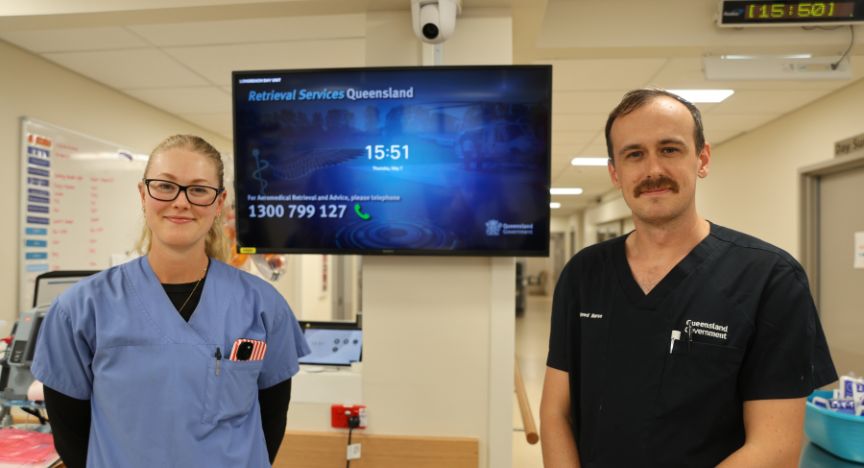
 Longreach Hospital radiographer Hannah Davison and Registered Nurse Callum Richardson with the high-definition Eye in the Sky camera behind them on the ceiling.
Two new ceiling mounted telehealth cameras have been installed in the Longreach Hospital’s operating theatre and the day surgery unit where tele-chemotherapy is delivered.
Queensland Health Rural and Remote Chief Information Officer Helen Murray said the two new high-definition ceiling cameras – colloquially known as “eyes in the sky’’ – joined two already actively used in the hospital’s emergency department and high dependency unit.
“The operating theatre camera is only the second to be installed in outback Queensland, giving a vital link to specialist expertise across the state,’’ Ms Murray said.
“Both cameras already have demonstrated how great an asset they are. Our clinical team is elated.’’
Longreach Hospital Director of Nursing Susanne Bardon said the camera in the day surgery unit was providing major benefits to how tele-chemotherapy was delivered.
“Our tele-chemotherapy service at Longreach was introduced in December 2018 with the support of Metro North Hospital and Health Service’s Royal Brisbane and Women’s Hospital (RBWH),’’ she said.
“The service allows nurses at Longreach, and at our other tele-chemotherapy service at Barcaldine Multipurpose Health Service, to administer anti-cancer drugs locally while being guided and advised via video link by specialised staff at RBWH.
“The new high-definition camera at Longreach allows for clinicians in Brisbane to have even closer monitoring of patients receiving treatment and supports our local nurses through being able to visually check the patient receiving treatment.
“The cameras are ‘high fidelity cameras’ that are so sophisticated it’s possible to see across the connection the details on the labels of the chemotherapy medications.’’
Ms Bardon said the new cameras would improve new and existing methods of treatment at distance and have benefits beyond those originally anticipated.
Ms Murray said “eyes in the sky” also had been installed in previous years at all nine Central West Hospital and Health Service primary health centres across the region, with the support of eHealth Queensland.
“Like the ones at Longreach, the remote primary health centre cameras are critical and provide a direct visual link between our remote facilities across western Queensland and clinicians at Retrieval Services Queensland Telehealth at Kedron in Brisbane, as well as Royal Flying Doctor Service clinicians,’’ she said.
“With the help of the cameras and other telehealth links, RSQ and RFDS clinicians can provide immediate support and advice to remote clinical staff to help them manage and stabilise patients before they are flown out for ongoing care.
“As a clinician myself, I can appreciate the enormous benefit of remote clinicians having specialist support right there in the room with you.
“In emergency situations, time is of the essence and immediate access to specialist support and advice can save lives and provide the best possible outcome for our patients.
“It’s a great sense of comfort for many sole practitioners in remote areas to have access to technology that can bring a specialist clinical care team from afar to your side – and this technology will only advance even further in the future. An example of which is the new cameras at the Longreach Hospital.’’