

Summary
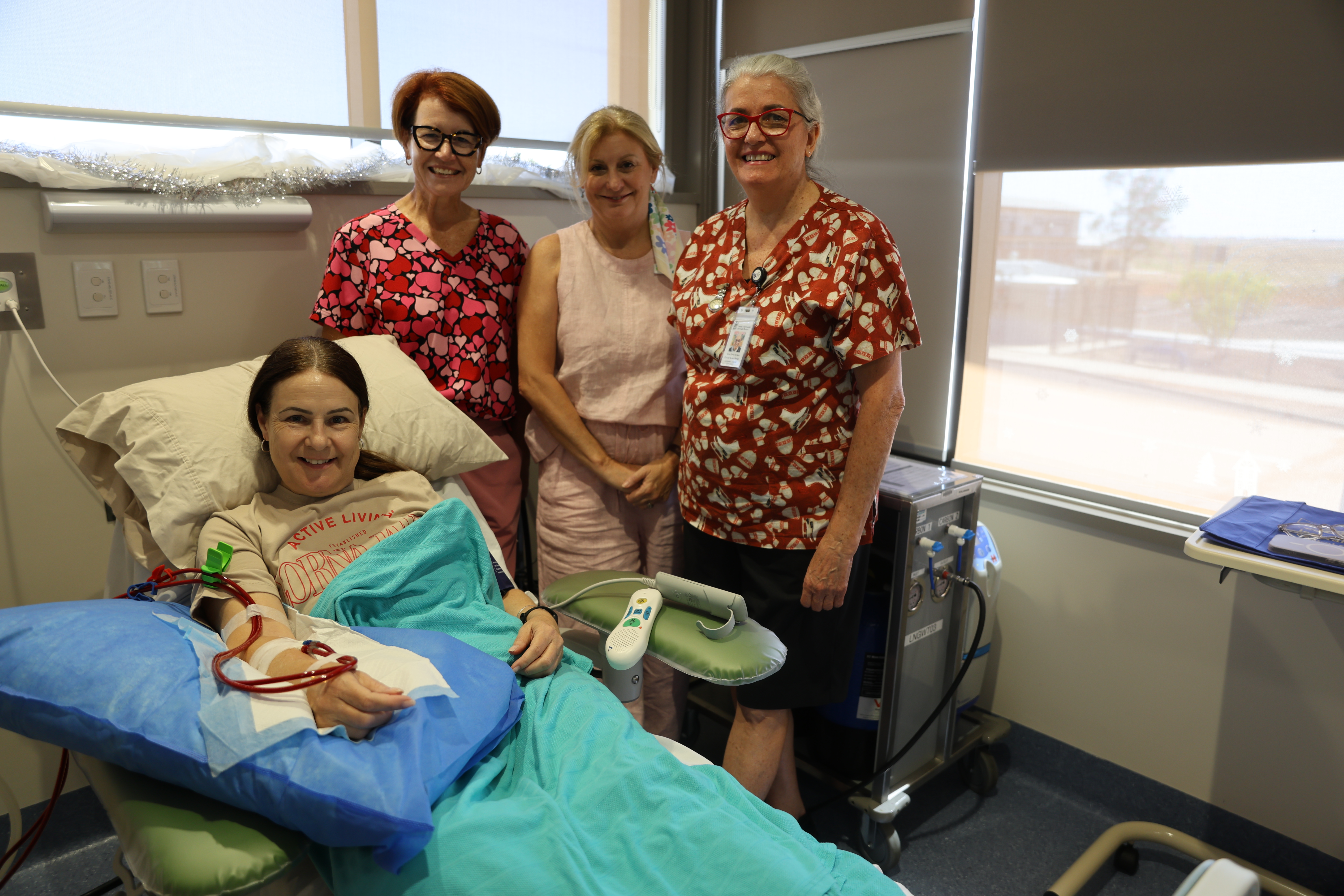
The Central West Renal Unit at Longreach Hospital has doubled its number of patients with Longreach resident Julie Maurer recently joining the unit.
The Central West Renal Unit at Longreach Hospital has doubled its number of patients with Longreach resident Julie Maurer recently joining the unit.
Ms Maurer is the fourth patient currently being managed by the unit.
She joins original patients Gordon Holland and Darren Amiguet who started in March this year, when the unit first opened, along with patient John Rose who joined the unit in June.
Mr Rose is the renal unit’s first Indigenous patient and was able to return to country from Gympie thanks to the new Longreach facility.
Ms Maurer said she had started dialysis about 18 months ago but had initially done peritoneal dialysis at home.
“But I started having difficulties with the peritoneal process and it was getting harder to manage at home, so I ended up going to the renal unit at Rockhampton Hospital earlier last month to dialyse there for a couple of weeks before coming back to Longreach,’’ she said.
“Having a dialysis unit here in town is a godsend as it means I didn’t have to relocate to Rockhampton or elsewhere to be able to dialyse with nursing support.
“It’s so convenient and allows me to remain at home here in Longreach where my family and friends are.’’
The three-chair dialysis unit – the first of its kind in the Central West region – was part of a $10.867 million package of works at Longreach Hospital that also delivered major upgrades and expansions to the hospital’s pharmacy, pathology, and Allied Health units when completed early this year.
Central West Renal Unit Clinical Nurse Consultant Julie Martin said the unit currently offered dialysis session from Mondays to Saturdays and had capacity to manage up to six patients
each day.
But as well as permanent patients, the Central West Renal Unit offers dialysis sessions to visitors and travellers in the region who are clinically suitable for dialysis in a satellite unit and who would like to take advantage of the service while travelling in the region.
“We’ve been able to offer dialysis sessions to five holiday patients so far this year and we already have holiday dialysis sessions booked in for next year,’’ Ms Martin said.
“People on haemodialysis must spend on average, five hours a day, three days per week connected to a haemodialysis machine.
“So, it’s very hard to go travelling anywhere unless you can be confident you can access your regular dialysis sessions while you are away from your home base.
“Having a dialysis unit here in Longreach means people don’t have to miss out coming out West for a holiday.’’
What is dialysis?
Dialysis is the mechanical cleaning of the blood and removal of excess fluid from the body required to sustain life when the kidneys are no longer able to perform this function.
There are two types of dialysis: peritoneal dialysis and haemodialysis.
In peritoneal dialysis the blood is cleansed inside the body using one of the body’s own membranes, the peritoneum, as a filter.
In haemodialysis, blood travels outside the body through tubing to a filter on a dialysis machine to remove wastes, excess fluids and to balance the person’s blood chemistry before being returned to the body.
Key statistics:
1 in 10 Australians have signs of kidney disease. This increases to 1 in 5 for Aboriginal and/or Torres Strait Islander people.
In Queensland, about 500,000 adults have indicators of chronic kidney disease.
90 per cent of kidney function can be lost without any symptoms – it is a silent disease.
Chronic kidney disease is common, harmful, treatable (if detected early) but often unnoticed.
The best way to find out if you have kidney disease is to undertake a Kidney Health Check, available from primary care providers.