

Summary
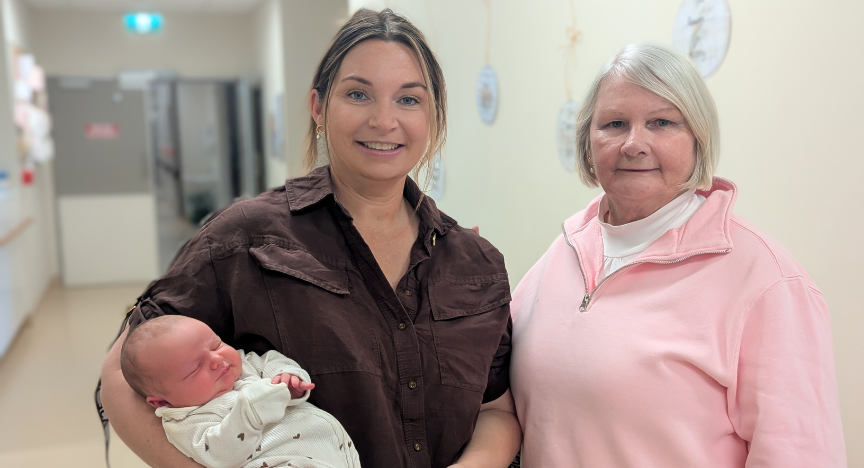
Born on 11 June, little Tannum Colin Moulds arrived at Longreach Hospital’s birthing unit with a very special pedigree.
Born to Ilfracombe couple Nicole and Ian Moulds, Tannum and his two older siblings, Jaxton, 7, and Phoebe, 5, are the fourth generation of their family born at Longreach.
Born on 11 June, little Tannum Colin Moulds arrived at Longreach Hospital’s birthing unit with a very special pedigree.
Born to Ilfracombe couple Nicole and Ian Moulds, Tannum and his two older siblings, Jaxton, 7, and Phoebe, 5, are the fourth generation of their family born at Longreach.
Their mother Nicole and grandmother Julie Groves also were born at Longreach Hospital, along with Julie’s mother, making four Longreach-born generations, while their other great-great-grandmother, May Doyle, was born at Windorah, making five generations born in the Central
West.
Even more striking, Tannum was born at Longreach on his grandmother, Julie Groves’s birthday, as well as what was his great-great-grandmother May Doyle’s birthday.
Mum Nicole Moulds said it had been a real family affair at Longreach Hospital.
“I had planned on having a C-section with Tannum but he came on early, so I had to go into theatre,’’ Mrs Moulds said.
“It was a great birthing experience as I already knew most of the theatre team, which put me at so much ease as I knew I was in the best hands.
“And being able to give birth so close to home at Longreach was so convenient, especially with the other children as we didn’t have to be split up.’’
Mrs Moulds said she would highly recommend other Central West women to give birth at Longreach.
“The midwives and doctors there are fabulous. And now the midwives are visiting me at home which is also great as it gives me a lot of added support.’’
Central West Hospital and Health Service Director of Child, Youth and Family Health Amanda Hackett said it was heartwarming for the Longreach Hospital maternity unit to be a part of a family’s life over multiple generations.
“Using a local birthing service such as ours at Longreach across multiple generations provides significant clinical, psychological, and social advantages for families,’’ she said.
“Birthing in a space that a family member previously used brings structural reassurance.
“When grandmothers, mothers, and daughters use the same regional maternity hub, it creates a unique continuum of trust, cultural safety, and highly personalised care.’’
Ms Hackett said on average, between 70–80 babies a year were born at Longreach Hospital.
“We also provide antenatal and postnatal care for about 120 women a year through our maternity service,’’ she said.
“In the Central West, maternity care providers include midwives providing care via a continuity of care midwifery group practice model, GP obstetricians, and the allied health care team, with ongoing follow up and referral to child health services.
“For a woman who lives out of Longreach, her midwife will liaise with the local midwifery staff in her community.
“Women also have the options of shared care with their regular GP or private obstetrician.’’
Ms Hackett said the Longreach Hospital maternity unit offered three post-natal rooms, a birth suite, a maternity assessment room, a baby assessment room, and an equipment room.
“The three single rooms on the maternity ward are big rooms with an ensuite but also an area where mums can bathe their babies,’’ she said.
“The birthing suite importantly also allows space for family to be with a woman and the birthing team during the birth of a baby if they choose.
“We also have on-site accommodation at no cost at Longreach Hospital for women in the leadup to giving birth from 37 weeks onwards.
“This is particularly convenient for women who live away from Longreach.’’