

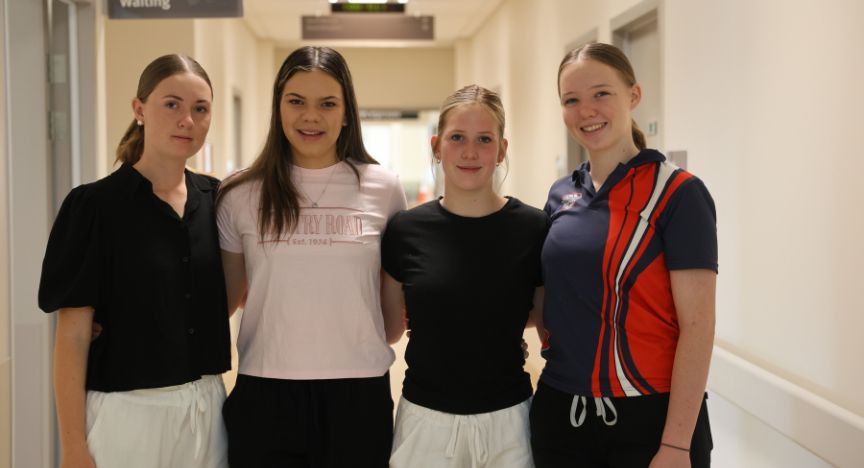
 Work experience students at Longreach Hospital – from left – Ella Pitman, Harlow Osbourne, Lara Jackson and Lily Worland, all from Longreach State High School.
The Central West Hospital and Health Service is working to overcome rural recruitment challenges by giving high school students the opportunity to experience working in a clinical environment.
Central West Health Learning Systems Advisor Bron Geiger said students could undertake short work experience placements at Central West hospitals or a full, two-year school-based trainee program covering years 11 and 12.
“During their two-year program, the students work for us one day a week during the school term and then they can do extra work, as suits them, during the school holidays,’’ Ms Geiger said.
“We are able to offer these work experience placements and traineeships thanks to the very significant efforts of our health service staff in supporting these young people throughout the year.’’
She said five school-based trainees – three at Longreach and two at Barcaldine – had either completed or were close to completing their two-year program.
The five students undertook Certificate III studies in the areas of Dental Assisting, Individual Support, Health Services Assistance and Business (Finance).
Three of the five students are already on the Central West Health casual staff pool while they take a gap year to further consider their future directions.
A sixth school-based trainee – at Longreach – who started late last year is due to complete a Certificate III in Dental Assisting next year.
Ms Geiger said a further eight students – six at Longreach and two at Barcaldine – were due to start their two-year traineeship program in late October.
They will be undertaking studies in pharmacy, Allied Health and nursing.
She said Central West Health also had two students participating in the First Nations Training Pathway Program, with one completing a nursing program at Tambo and the second about to start an Occupational Therapist cadetship at Longreach.
“We all know the difficulties experienced in rural regions in attracting and retaining staff, whether clinical or non-clinical,’’ Ms Geiger said.
“By supporting and providing opportunities for school-based trainees as well as work experience, we are, in effect, helping to grow our own workforce.
“It’s a workforce model that focuses on attracting, developing, supporting, and retaining local residents to create a sustainable pipeline of workers for our future workforce, as well as supporting the communities in which we live and work.’’
Ms Geiger said, as well as the school-based trainees, Central West Health had hosted 17 students so far this year for short work experience placements at health facilities.
“Our Allied Health team recently hosted five school students at Longreach Hospital, and we also have had placements at Barcaldine and Winton multipurpose health services,’’ she said.
“As well as Allied Health, this year’s work experience students have also had placements with our medical, nursing, Oral Health and Operations teams.
“Most of the 17 work experience students have come from local high schools.
“However, we have also hosted students from the Gold Coast, Yeppoon and Rockhampton, who either have family locally or are attending school outside the region but have a strong interest in the outback.
“It’s a great way of introducing the future generation of workers to the benefits and advantages of working in our region.’’
Ms Geiger said the school-based trainee program had proved so successful, that the health service had engaged with group training organisation Golden West to deliver future participants.
“Central West Health will continue hosting the trainees, but they will be delivered and managed by Golden West,’’ she said.