

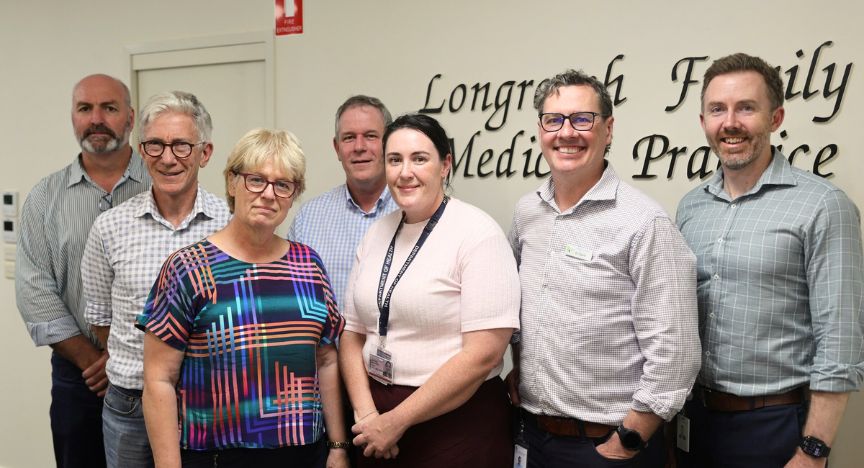
 National Rural Health Commissioner visits Longreach – from left – Federal Department of Health Assistant Secretary Stewart Webster, Office of Rural and Remote Health Senior Clinical Lead Prof. Richard Murray, National Rural Health Commissioner Prof. Jenny May, Central West Health Director of Clinical Training Dr John Douyere, Office of Rural and Remote Health Executive Director Elisha McGuiness, Central West Health Executive Director of Medical Services Dr David Walker and Central West Health Connected Care Project Director Tim Effeney.
The National Rural Health Commissioner has visited Longreach to see first-hand how the Central West Hospital and Health Service’s successful medical practice model works.
The Commissioner, Prof. Jenny May, visited the Longreach Family Medical Practice and Longreach Hospital as part of a fact-finding visit.
Central West Health owns and operates five GP practices in Barcaldine, Winton, Alpha and Blackall, as well as Longreach.
Central West Health Executive Director of Medical Services Dr David Walker said the health service’s medical practice model illustrated the important role of rural and remote clinical supervision in strengthening services and developing a self-sustaining workforce.
“In previous years, Central West Health experienced difficulties in recruiting and retaining doctors in the region. A new approach was needed,’’ he said.
“As such, a new medical workforce model was developed.
“This was based on the idea of a group practice where all doctors are paid as Senior Medical Officers, employed by Central West Health and work in our GP practices as well as our hospitals.
“All our SMOs, all of whom have advanced skills in other areas of medicine apart from general practice, work as part of a single Central West Health-wide medical pool servicing our hospitals, health centres and GP practices.
“This allows them, as a team, to provide patients with a higher level of care.
“It also allows us to provide patient-centred clinical care that is delivered by appropriately skilled clinicians, in a timely fashion, as close to home as is safe.
“Just as importantly, having such a pool of senior and highly skilled doctors has given Central West Health the capacity to host, teach and supervise the next generation of young doctors.
“That’s why we are also able to host doctors at most stages of career training for Rural Generalist specialty training throughout the region.
“In addition, we host other medical students from earlier stages of their course from institutions throughout Australia. These students do shorter rotations of between two and six weeks in our region as an introduction to the West.
“This is a great way of introducing the future generation of doctors to the benefits and advantages of working in rural practice.’’
Dr Walker said, because of its unique medical model strategy, the Central West was seen as increasingly attractive for both senior and junior doctors looking for new challenges.
“It’s a medical practice model that could be of use in other rural areas of Australia as well,’’ he said.